
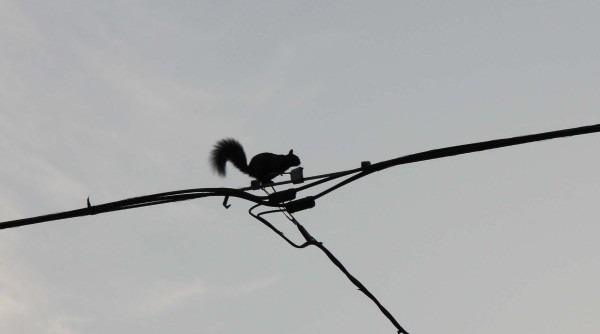
On 21 October 2014, parts of Providence, Rhode Island experienced a blackout for two hours. Local media reported that a squirrel entered a power station and became a conductor, knocking out electricity.
Is it possible to create an electricity supply system that is robust to invading creatures? Or is this truly a “natural disaster” since the squirrel is part of the natural system–albeit adapted to the urban life and exposing vulnerabilities of human infrastructure? When planning for power outages, how much should squirrels be factored in?
Some private companies make good money modelling blackout frequency, severity, and consequences. Should their models incorporate, even as a “random” factor, infiltrating rodents?
The Squirrel Factor goes beyond localised electricity failures. In December 2014, at the American Geophysical Union’s Fall Meeting in San Francisco, one presentation described how squirrels contribute to climate change.
According to their research, Arctic ground squirrel burrows in Siberia warm the surrounding soil contributing to permafrost melt and hence releasing greenhouse gases. Yet complex feedback cycles involve nitrogen, plus climate change could affect squirrel populations and thus burrow numbers.
How could these animalistic challenges be incorporated into equations, models, and calculations supporting sustainability work, whether related to climate change or electricity? Do we need to?
Perhaps the sustainability key is not being prepared for everything. Instead we ought to be creative, adaptable, and flexible to deal with anything which manifests, squirrel-related or otherwise.
The bad news is that the squirrel in Providence did not survive.
Ilan Kelman is a reader in Risk, Resilience and Global Health at University College London.
MAHB-UTS Blogs are a joint venture between the University of Technology Sydney and the Millennium Alliance for Humanity and the Biosphere. Questions should be directed to joan@mahbonline.org
MAHB Blog: https://mahb.stanford.edu/blog/the-squirrel-factor/