

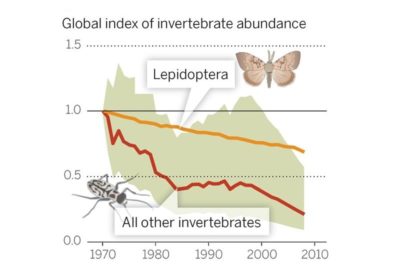
Paul Ehrlich could not have known when he wrote The Population Bomb with Anne Ehrlich in 1968 that mankind would respond by investing a vast quantity of our precious, shrinking resources to prop up unprecedented levels of population growth, rather than trying to prevent it. He could not have foreseen that the uncountable billions of the invertebrate world would be cut in half, in a matter of 40 years. Fifty years later, he must be appalled that human population has more than doubled, at the expense of all other species and many rare resources!
He must surely be driven to distraction by the global ignorance of these facts, and of their fearful consequences! But like the rest of us, he soldiers on and tries to find a way to influence the dense thickets of human indifference.
We now know that the only way to minimise a huge die-off, and to avert the accompanying environmental destruction, would be to stop and then quickly reverse population growth. We also recognise the arithmetical fact that only universal, voluntary, one-child families could produce that change – however unlikely it is that we could achieve global agreement to it (See Population Workbook).
But we must try – and meanwhile, plan how best to deal with nature’s imposed solution of human deaths rapidly accelerating into billions. And at the same time, we must find the best way to minimise the inevitable war-torn competition for resources, fast-growing starvation, epidemic levels of disease and massive movements of people who in their fight to survive, will not respect any political boundaries.
In considering these threats my heart sinks as I contemplate the millions of men around the world, beating their chests in pride at the number of children they are fathering – not realizing that they are operating a self-destruct mechanism. My attention is drawn to new figures about male fertility – reaching an appalling 13.6 in Niger. It is above 8.5 children per man in half of the 41 sub-Saharan countries for which we have data, and above 10 children in one quarter of them. It is time that we openly confront the males of our species about the incredible global damage they are causing – and about their ancient and outdated belief that females are inherently inferior.
And it is also time that the UN Organisation was able to negotiate the freedom to move from merely supplying population figures, to an active and wholly involved position in fighting population growth. The forces marshaled against our so-far puny efforts to control population are massive and relentless.
“Gaia, the living biosphere, is infested with humans. Not just any humans, but the type that grow fat and reproduce exponentially by liquidating natural ecosystems. The population bomb has burst and we are seeing daily the predicted consequences of collapse and death in the climate, water, oceans, and on the land. Having spent much of my life working to protect Earth’s last naturally evolved primary forests from logging for inequitable over-consumption, I am today ready to declare defeat. Preserving Earth’s last large old-growth forests is a lost cause as there are simply too many people.”
If we are going to make any real progress on these problems, most of the world must know the true facts – and most of them do not. Perhaps with UN assistance, we may begin with each of the world’s leaders and then move to influence education systems. How can we expect wide understanding of our plight, if all the facts are not made easily available and are not part of world-wide education systems?
Those facts must include at least:
• The numbers and distribution of world population.
• An overview of how these numbers have changed – and are changing.
• The arithmetic facts about the necessity for one-child families.
• A summary of the world-wide destruction we are wreaking – including climate-change.
To make those facts understandable and credible is a massive challenge for all of us. Let us begin now!
The MAHB Blog is a venture of the Millennium Alliance for Humanity and the Biosphere. Questions should be directed to joan@mahbonline.org
MAHB Blog: https://mahb.stanford.edu/blog/call-to-arms/
The views and opinions expressed through the MAHB Website are those of the contributing authors and do not necessarily reflect an official position of the MAHB. The MAHB aims to share a range of perspectives and welcomes the discussions that they prompt.